1
The honest version (Urdu)
The one you would rather not send, which is usually the one that works.
مجھے سچ میں افسوس ہے۔ غلطی میری تھی، اور میں کوئی بہانہ نہیں بناؤں گا۔
Urdu carries more poetic weight per line than almost any other option, which suits emotional messages. Every message below is written in Urdu, not translated word-for-word from English, so it reads the way your brother-in-law actually speaks. Each one is paired with an English line you can send alongside it.
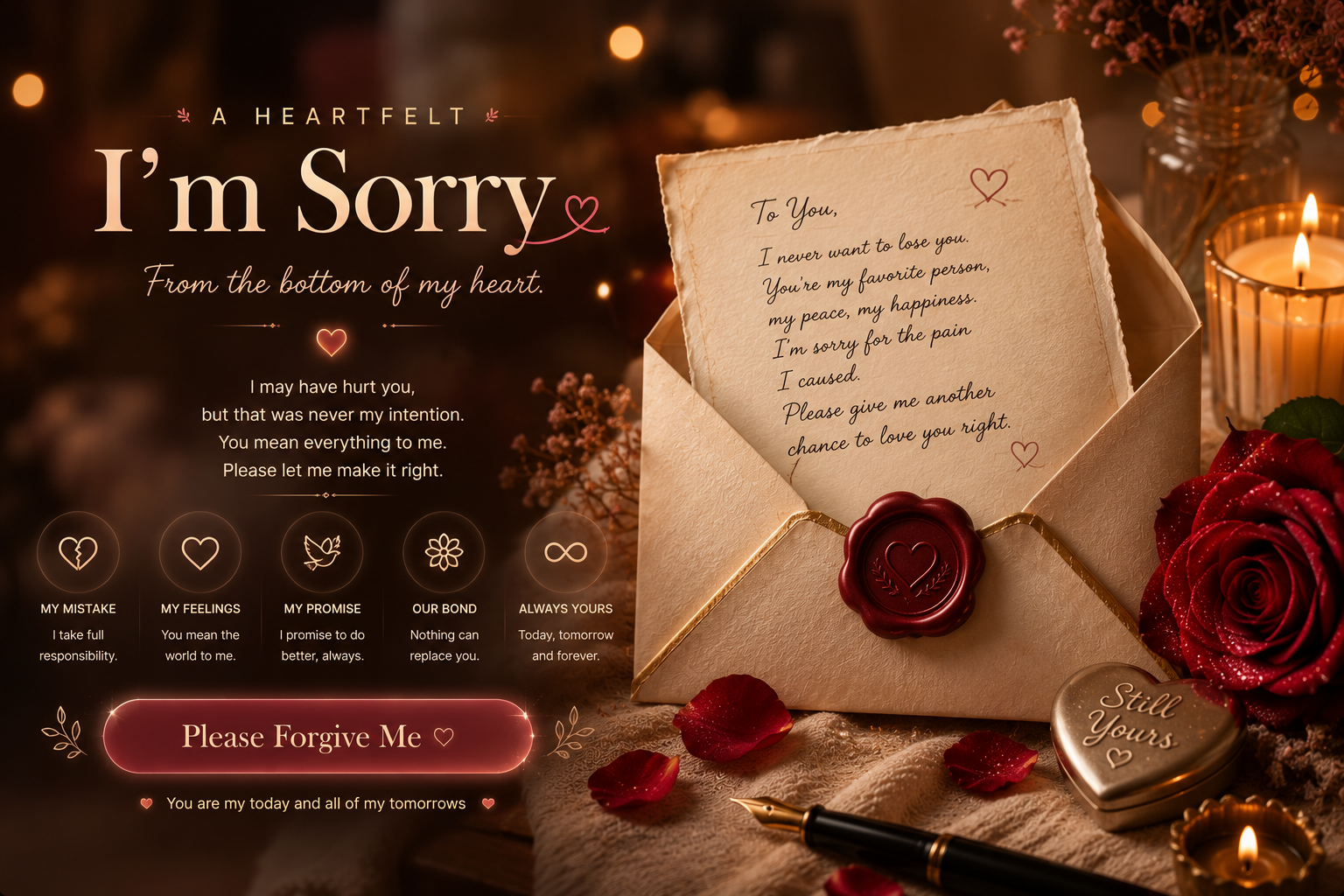
The best sorry wishes for a brother-in-law in Urdu are short, spoken-sounding lines written directly in Urdu rather than translated from English — translation is what makes a forwarded message obvious. On BuildNectic you can also send a personalised sorry website — a private apology page that opens slowly instead of in a notification bar — your words paced line by line, your photos, and a folded paper letter they unfold themselves — which arrives as a single private link on WhatsApp and needs no app or account to open.
The one you would rather not send, which is usually the one that works.
مجھے سچ میں افسوس ہے۔ غلطی میری تھی، اور میں کوئی بہانہ نہیں بناؤں گا۔
So the night does not do the damage that the argument started.
مجھے معاف کر دیجیے۔ مجھے معلوم ہے میں نے آپ کو دکھ دیا۔
For sending while it is still raw, when anything long will read as a defence.
میں بحث نہیں کرنا چاہتا۔ بس معافی مانگنا چاہتا ہوں۔
Asks for nothing, so there is nothing they have to decide right now.
جب آپ تیار ہوں تب بات کر لیجیے۔ میں یہیں ہوں، اور مجھے افسوس ہے۔
For the relatives and friends who read English more comfortably than they read the script.
I was wrong. I am sorry. No excuse for it.
For the relatives and friends who read English more comfortably than they read the script.
I have written this three times and deleted it twice, which probably tells you how much I have been thinking about it. I was wrong. Not partly wrong, not wrong-in-context — wrong. You raised something that mattered to you and I treated it like an inconvenience, and then when you reacted I acted like the reaction was the problem. It was not. I was. I am sorry. I am not asking you to move past this on my timeline. I only want you to know that I understand what I did and that I am not planning to repeat it.
For the relatives and friends who read English more comfortably than they read the script.
I am sorry, and I am also aware this is not the first time. The honest version is that I get defensive the second I feel criticised, and then I make you handle my defensiveness instead of the actual issue. That is a pattern and it is mine to fix.
A long apology in a chat window gets read in three seconds between other notifications. The same words on a private page open slowly — one line at a time, with old family and childhood photos behind them and a folded letter they unfold themselves. Same words, completely different reception.
Create the apology page for your brother-in-lawPut down what you actually want to say, with as much space as it needs.
Attach the pictures that remind them why this is worth repairing.
Share it privately — no app, no account, nothing for them to install.
Urdu is read right-to-left, so keep each message to one or two lines — long right-to-left paragraphs break awkwardly in WhatsApp previews and lose their rhythm. And read it aloud before sending — if it sounds like a newsreader rather than like you talking to your brother-in-law, rewrite it shorter.
Urdu carries more poetic weight per line than almost any other option, which suits emotional messages. A message in someone’s first language is processed faster and more emotionally than the same message in their second. For parents and grandparents especially, Urdu is not a stylistic choice — it is the difference between reading a message and feeling it.
The best sorry wishes for a brother-in-law in Urdu are short, spoken-sounding lines written directly in Urdu rather than translated from English — translation is what makes a forwarded message obvious. On BuildNectic you can also send a personalised sorry website — a private apology page that opens slowly instead of in a notification bar — your words paced line by line, your photos, and a folded paper letter they unfold themselves — which arrives as a single private link on WhatsApp and needs no app or account to open.
Yes, and it is the option most people are switching to. A BuildNectic sorry website is a private apology page that opens slowly instead of in a notification bar — your words paced line by line, your photos, and a folded paper letter they unfold themselves. You personalise it in a few minutes, get a private link, and send it on WhatsApp — your brother-in-law opens it in their browser with nothing to install and no account to create.
Shorter than you think. A long apology reads as a defence, because length invites explanation and explanation invites excuses. Two or three sentences that name what you did, without a single "but", outperform a paragraph almost every time — save the longer version for when you are face to face with your brother-in-law.
No. The link opens full-screen in any browser on any phone or laptop — no download, no sign-up, nothing for your brother-in-law to install. It works on Android and iPhone, and it stays online afterwards so they can reopen it later.
Yes. Urdu (اردو) renders correctly on every modern Android and iOS device and inside WhatsApp, Instagram and email. If you are worried about an older device, send the English line alongside it — each message above has one.
A long apology in a chat window gets read in three seconds between other notifications. The same words on a private page open slowly — one line at a time, with old family and childhood photos behind them and a folded letter they unfold themselves. Same words, completely different reception.
Create the apology page for your brother-in-law